Critical Data Transmission Security Design Guide
An implementable engineering blueprint to protect critical data in transit — enforcing encryption, trusted identity, controllable paths, minimal exposure, auditability, and forensic readiness across hybrid enterprise environments.
System Overview
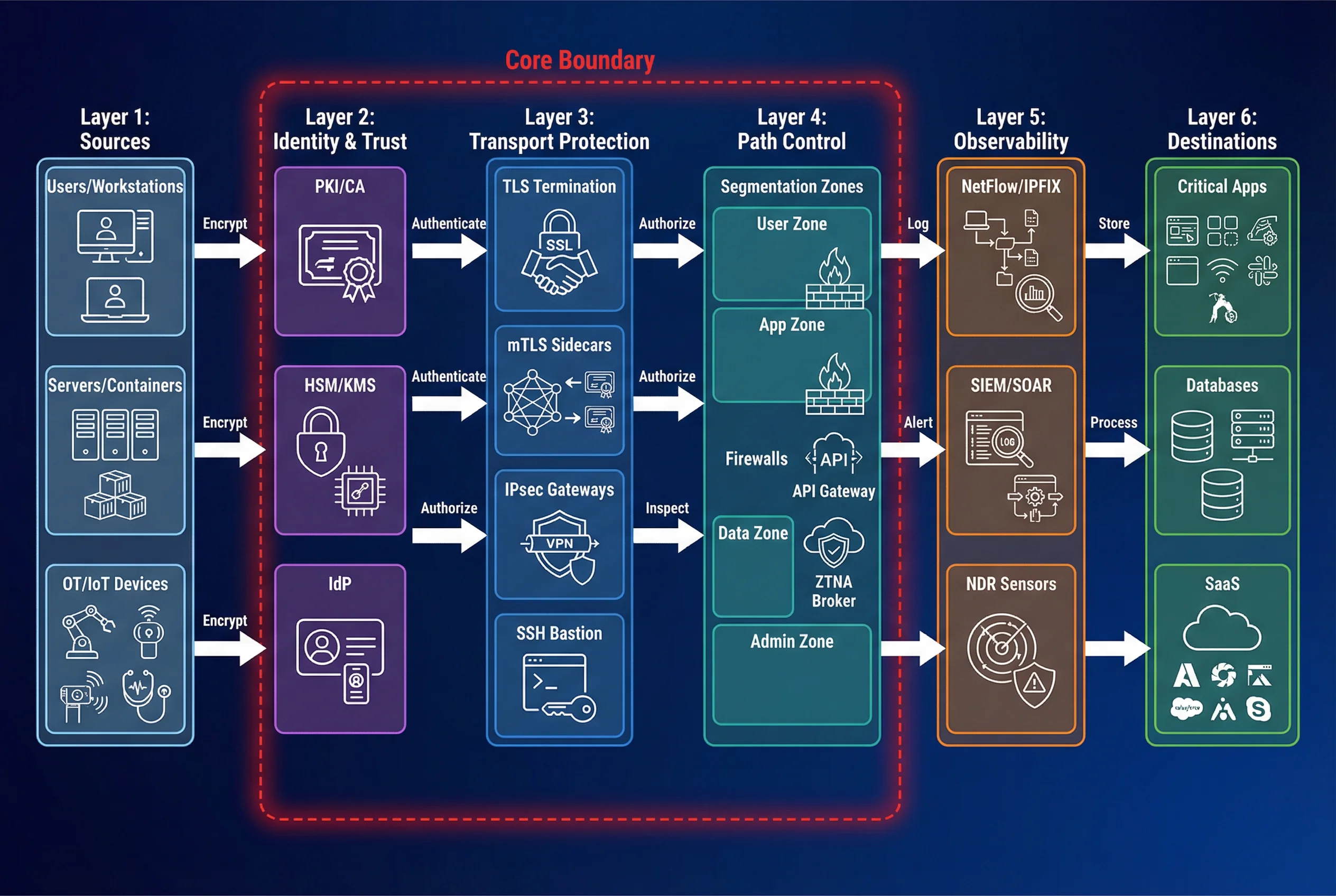
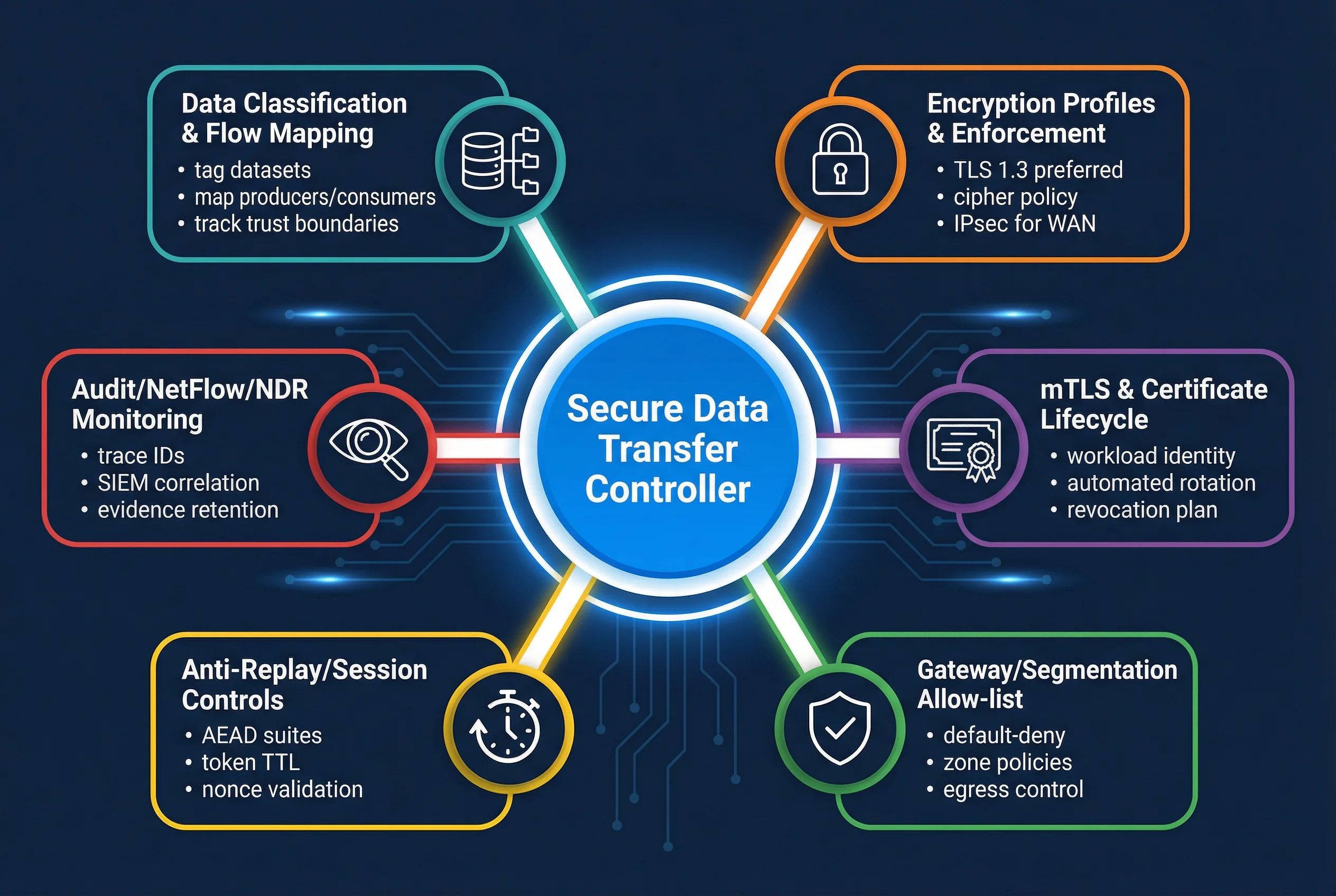
This design guide defines an implementable engineering blueprint to protect critical data in transit by simultaneously enforcing encryption protection, trusted identity, controllable paths, minimal exposure, auditability, and forensic readiness. The target outcome is not "encryption in theory," but a transport system where the organization can prove: what data moved, between which identities, over which approved channels, with which cryptographic posture, and with what evidentiary logs if something goes wrong.
The guide addresses data transfer across user-to-app, service-to-service, site-to-site, cloud-to-on-prem, admin operations, batch transfers, API calls, file transfers, and replication flows. It covers protocols including TLS 1.2+/TLS 1.3, IPsec/VPN, SSH/SFTP, secure message queues, and approved application tunnels, along with the full control plane encompassing PKI/certificates, key lifecycle, access control, segmentation, gateways, zero trust/conditional access, and telemetry.
The core value proposition is to reduce the probability and blast radius of interception, tampering, replay, credential misuse, and unauthorized lateral movement, while increasing detection speed and post-incident traceability. Typical delivery artifacts include a data-flow inventory, mTLS profile, VPN/IPsec profile, API gateway standards, firewall matrices, certificate rotation plan, audit and NetFlow dashboards, and an acceptance test pack.
Key Design Parameters
The guide is built around a hybrid deployment topology combining on-premises data centers, branch sites, public cloud (IaaS/PaaS), and SaaS, interconnected via Internet, MPLS/leased lines, and cloud interconnect. It handles north–south, east–west, machine-to-machine (OT/IoT), and data replication/backup traffic flows.
| Parameter | Specification | Notes |
|---|---|---|
| TLS Version | TLS 1.3 preferred; TLS 1.2 hardened | Disable TLS 1.0/1.1 and SSL |
| Cipher Policy | AEAD only (AES-GCM, ChaCha20-Poly1305) | Forward secrecy required |
| Certificate Lifetime | 24–72 hours (automated) or ≤30 days | Shorter reduces exposure window |
| Token TTL (high-risk) | 5–15 minutes | Require refresh & revocation |
| Gateway HA Failover | ≤30 seconds | Health check tuning required |
| Availability Target | ≥99.9% critical; ≥99.99% Tier-0 | Redundancy for gateways and key paths |
| Log Ingestion Delay | ≤2 minutes | For timely alerting |
| NetFlow Coverage | ≥90% of critical chokepoints | Validate regularly |
| Delivery Timeline | 8–16 weeks | Phased rollout recommended |