Design Methods
2.1 Design Principles and Basis
Effective secure data transfer design is grounded in a set of executable engineering principles — not aspirational statements, but actionable controls that can be implemented, tested, and verified. Each principle below is tied to a specific threat or failure mode, a context where it applies, and the standards or operational experience that justify it. Organizations should treat these as a checklist during design review, ensuring every critical data path can be traced back to at least one governing principle.
| # | Principle (Executable) | Why | Applies When | Basis Type |
|---|---|---|---|---|
| 1 | Classify data and map flows before applying controls | Protect real paths, avoid gaps | Any critical data program | Policy + architecture |
| 2 | Prefer TLS 1.3; allow TLS 1.2 only with hardened suites | Reduce downgrade/legacy risks | Most HTTP/gRPC | Standards + risk |
| 3 | Use mTLS for service-to-service and privileged machine links | Stop rogue endpoints | Microservices, batch, OT collectors | Zero-trust principle |
| 4 | Terminate external traffic only at controlled gateways | Shrink attack surface | Internet/partner access | Network security practice |
| 5 | Default-deny segmentation; allow-list per identity and port | Reduce lateral movement | Multi-zone networks | Least privilege |
| 6 | Manage keys as lifecycle assets (create→distribute→rotate→revoke) | Prevent key aging/compromise | Any cryptographic deployment | Cryptographic hygiene |
| 7 | Enforce anti-replay and strict session TTL | Prevent reuse attacks | APIs, tokens, signed requests | Threat modeling |
| 8 | Ensure strong time integrity (NTP security) | Logs and cert validation depend on time | All environments | Operational dependency |
| 9 | Log forensics-first: identity, path, policy decision, trace ID | Enable investigations | Critical flows | IR requirements |
| 10 | Use egress control and DNS governance to stop exfil paths | Exfil often uses outbound | Cloud/hybrid | Real-world incident pattern |
| 11 | Separate duties for key access and traffic inspection | Reduce insider abuse | TLS inspection zones | Governance |
| 12 | Continuously validate posture (config drift & scanning) | Security decays over time | Long-lived systems | O&M reality |
2.2 Failure Causes and Recommendations
Security failures in data transfer systems rarely stem from a complete absence of controls — they more often result from controls that are present but misconfigured, incomplete, or unmanaged over time. The following analysis maps common failure causes to their underlying mechanisms and provides actionable avoidance recommendations. Each pattern is drawn from real-world incident investigations and audit findings across enterprise and critical infrastructure environments.
| Failure Cause | Failure Mechanism | Avoidance / Recommendation |
|---|---|---|
| "We enabled TLS" but kept weak ciphers | MITM feasible, downgrade possible | Ban weak suites; enforce TLS 1.3; scan continuously |
| No flow inventory | Critical path bypasses controls | Maintain flow map repo; gate changes on flow approval |
| Over-broad firewall rules | Lateral movement + data exfil | Default-deny; zone boundaries; rule review with owners |
| Long-lived certificates | Stolen cert remains valid | Short-lived certs; automated rotation; revoke quickly |
| No revocation plan | Compromised identity remains trusted | OCSP/CRL strategy; rapid revocation runbook |
| TLS inspection without controls | Keys leak, privacy violations | Controlled decryption zones; HSM; audit; least privilege |
| Logs not correlated | Incidents invisible | Standard trace IDs; SIEM correlation rules; time sync |
| VPN tunnels unmanaged | Split tunneling or route leaks | Route-based IPsec; monitoring; periodic rekey tests |
| Admin access direct to servers | Credential theft escalates | SSH bastion; MFA; session recording |
| Cloud endpoints publicly exposed | Internet scanning hits private services | PrivateLink/VPC endpoints; gateway-only exposure |
2.3 Core Design / Selection Logic
Selecting the right transport protection mechanism for a given data flow requires a structured decision process. The decision tree below guides engineers from the initial data classification question through protocol selection, termination point decisions, partner/cross-domain considerations, and inspection requirements, culminating in the requirement to enable observability and define acceptance tests. The key insight is to always prefer the highest-layer control feasible — mTLS at the application layer binds identity and context most tightly — and fall back to lower layers only when application-layer control is not achievable.
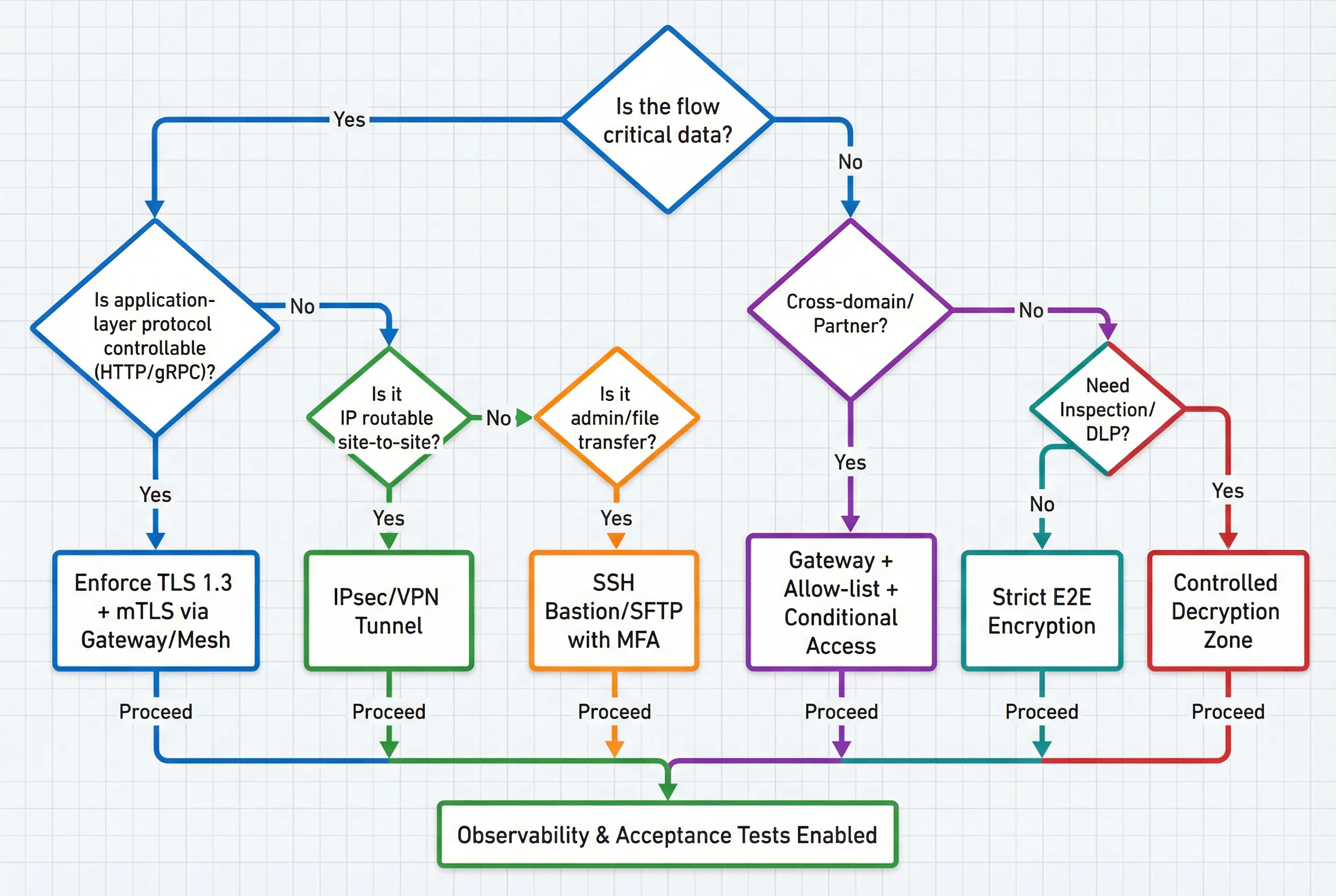
Step-by-Step Decision Logic
- Identify the data class and business owner for the flow under review.
- Map endpoints (producer/consumer), identity types, and trust boundary crossings.
- Choose preferred protection: TLS 1.3/mTLS (app-level) → IPsec (network-level) → SSH (admin/file).
- Decide termination points: gateway vs. direct mTLS based on operational capability.
- Apply segmentation rules and egress constraints to the approved path.
- Define key/cert lifecycle and automation requirements for the chosen mechanism.
- Define logging, NetFlow coverage, alerts, and forensics retention for the flow.
- Define acceptance tests and operational runbooks before go-live.
2.4 Key Engineering Dimensions
Beyond protocol selection, secure data transfer design must be evaluated across multiple engineering dimensions to ensure the solution is not only secure but also performant, maintainable, compliant, and cost-effective. The table below provides practical design notes for each dimension, helping engineers balance competing constraints during architecture reviews.
| Dimension | What to Measure | Practical Design Notes |
|---|---|---|
| Performance / UX | Latency overhead, handshake rate | Session reuse, keepalive, hardware TLS acceleration; target p95 overhead ≤15ms |
| Stability / Reliability | Failover time, tunnel uptime | HA gateways, dual links, health checks; target ≤30s failover for Tier-0 |
| Maintainability / Replaceability | Rotation success rate, config drift | Automation, golden templates, staged rollout; rotation success ≥99.5% |
| Compatibility / Expansion | Protocol support, scale limits | Standard profiles, modular gateway patterns; avoid bespoke cipher exceptions |
| Lifecycle Cost (LCC) | License + ops time | Reduce bespoke rules, central policy management; automation reduces ops burden |
| Energy / Green | Device power, PoE sizing | Right-size appliances, consolidate taps; avoid over-provisioned hardware |
| Compliance | Audit trails, crypto policy | Documented controls + evidence retention mapped to ISO 27001/NIST/PCI DSS |