Quality & Acceptance
10.1 Acceptance Testing Framework
Acceptance testing for critical data transmission security systems must be structured, documented, and executed against pre-agreed criteria before any system is placed into production service. The acceptance testing framework covers four dimensions: physical installation quality, functional verification, performance benchmarking, and security posture validation. Each dimension has defined pass/fail criteria, and all four must pass before the system is accepted. The framework is designed to be executed by a joint team comprising the installation contractor, the customer's IT security team, and an independent third-party auditor for high-assurance environments.
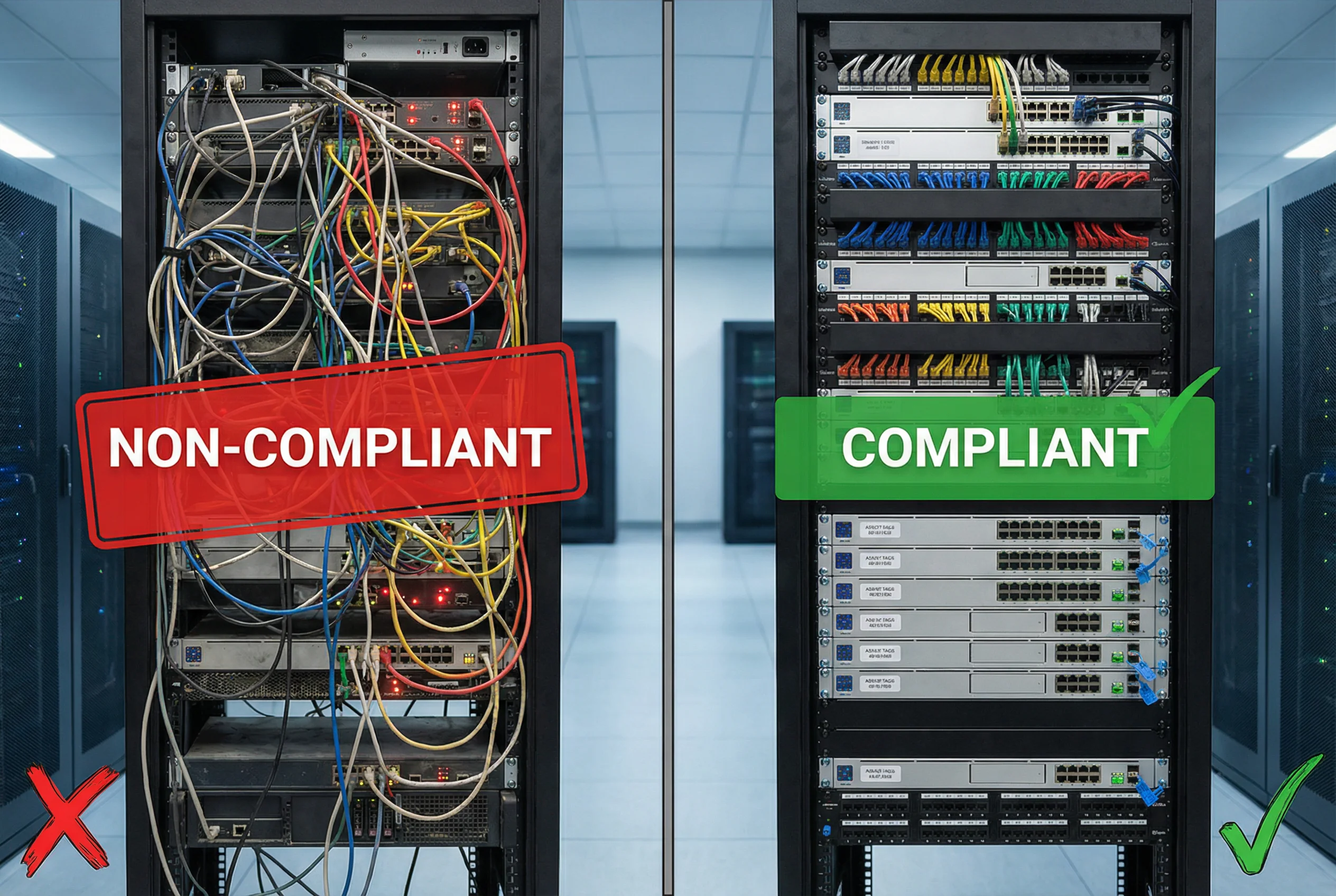
The quality comparison below illustrates the difference between a non-compliant and a compliant installation, providing a visual reference for acceptance inspectors. Common non-compliance findings include cable management failures, missing asset tags, absent blanking panels, and indicator light anomalies — all of which must be remediated before acceptance sign-off.
10.2 Physical Installation Acceptance Criteria
Physical installation quality directly affects long-term reliability, maintainability, and security. The acceptance criteria below define the minimum standards for physical installation quality, with each item classified as a Critical finding (must remediate before acceptance) or a Major finding (must remediate within 30 days of acceptance).
| # | Inspection Item | Acceptance Criterion | Finding Class | Verification Method |
|---|---|---|---|---|
| 1 | Cable Management | All cables bundled, routed through cable managers, no free-hanging cables > 30cm | Critical | Visual inspection; photograph |
| 2 | Cable Labeling | Both ends of every cable labeled with port ID and destination; labels legible and durable | Critical | Visual inspection; spot-check 10% of cables |
| 3 | Blanking Panels | All empty rack units filled with blanking panels; no open gaps in rack | Major | Visual inspection; count empty U positions |
| 4 | Asset Tags | Every device has an asset tag; tag number recorded in CMDB before acceptance | Critical | CMDB audit; visual inspection |
| 5 | Tamper-Evident Seals | Seals applied to all chassis screws; seal numbers photographed and recorded | Critical | Visual inspection; photograph; log review |
| 6 | Grounding | All racks bonded to facility ground; ground resistance < 1 Ohm measured at each rack | Critical | Ground resistance measurement; certificate |
| 7 | Power Redundancy | Dual PSUs connected to separate PDUs on separate circuits; UPS on each PDU feed | Critical | Trace power path; test PDU failover |
| 8 | Indicator Lights | All device status LEDs show green/normal; no amber or red indicators at acceptance | Critical | Visual inspection; device status check |
| 9 | Port Documentation | Port assignment diagram completed and matches physical installation | Major | Compare diagram to physical; spot-check 20% of ports |
| 10 | Cable Lengths | No cable slack > 15cm after routing; no cable tension (no pulling on connectors) | Major | Visual inspection; tug test on 10% of cables |
10.3 Functional Acceptance Test Cases
Functional acceptance testing verifies that each security control operates as designed under normal and adverse conditions. The test cases below represent the minimum required functional tests. Each test must be executed, results documented, and pass/fail status recorded by the acceptance team.
| Test ID | Test Case | Test Method | Expected Result | Pass Criterion |
|---|---|---|---|---|
| FAT-01 | TLS 1.3 Enforcement | Attempt connection with TLS 1.0, 1.1, 1.2 (no cipher restriction), and TLS 1.3 | TLS 1.0/1.1 rejected; TLS 1.2 accepted only with AEAD ciphers; TLS 1.3 accepted | 100% of legacy connections rejected |
| FAT-02 | Certificate Validation | Present expired cert, self-signed cert, revoked cert, and valid cert | Expired/self-signed/revoked rejected; valid cert accepted | All invalid certs rejected; valid cert accepted |
| FAT-03 | IPsec Tunnel Establishment | Initiate IKEv2 tunnel with correct and incorrect PSK/cert | Correct credentials: tunnel up; incorrect: tunnel rejected | Tunnel up in < 5 sec; incorrect credentials rejected |
| FAT-04 | MFA Authentication | Attempt SSH bastion login with password only, then with password + OTP | Password-only rejected; password + OTP accepted | 100% password-only attempts rejected |
| FAT-05 | Failover / HA | Simulate primary appliance failure; verify traffic continues via secondary | Failover completes; no new connections dropped after failover | Failover time < 30 sec; zero packet loss after failover |
| FAT-06 | SIEM Log Delivery | Generate test events; verify receipt in SIEM within SLA | All test events appear in SIEM with correct timestamp and source | 100% event delivery; timestamp drift < 1 sec |
| FAT-07 | DLP Policy Enforcement | Attempt to transmit test PII/PCI data pattern through monitored channel | DLP detects and blocks/alerts on policy violation | 100% of test violations detected; alert generated in < 5 sec |
| FAT-08 | NAC Posture Check | Connect non-compliant device (missing patch); verify quarantine VLAN assignment | Non-compliant device placed in quarantine VLAN; compliant device gets production VLAN | Quarantine enforced within 30 sec of connection |
10.4 Performance Acceptance Benchmarks
Performance benchmarks establish the minimum throughput, latency, and availability thresholds that the system must meet under production load conditions. All benchmarks must be measured using production-representative traffic profiles, not synthetic micro-benchmarks.
| Metric | Minimum Threshold | Target | Measurement Method | Duration |
|---|---|---|---|---|
| TLS Throughput | ≥ 90% of rated capacity | ≥ 95% of rated capacity | iperf3 with TLS wrapper; bidirectional | 30 min sustained |
| TLS Handshake Latency | ≤ 50 ms avg (LAN) | ≤ 20 ms avg (LAN) | openssl s_time; 1000 handshakes | Single test run |
| IPsec Tunnel Throughput | ≥ 85% of rated capacity | ≥ 92% of rated capacity | iperf3 through IPsec tunnel | 30 min sustained |
| IPsec Failover Time | ≤ 30 sec | ≤ 10 sec | Simulate primary failure; measure traffic restoration | 3 test runs; average |
| SIEM Event Processing | ≥ rated EPS capacity | ≥ 110% of rated EPS | Log generator at rated EPS; verify zero loss | 15 min sustained |
| System Availability | ≥ 99.9% (30-day) | ≥ 99.95% (30-day) | Uptime monitoring; planned maintenance excluded | 30-day post-acceptance |
| Certificate Issuance Time | ≤ 5 sec per cert | ≤ 2 sec per cert | ACME client; 100 sequential requests | Single test run |