Selection & Interfaces
5.1 Core Product Showcase
The critical data transmission security solution is built on five core product categories, each addressing a distinct security function in the architecture. Together, these products form a complete, defense-in-depth stack that covers transport encryption, identity management, privileged access control, and security observability. The following illustration presents the five core appliance categories with their primary specifications.
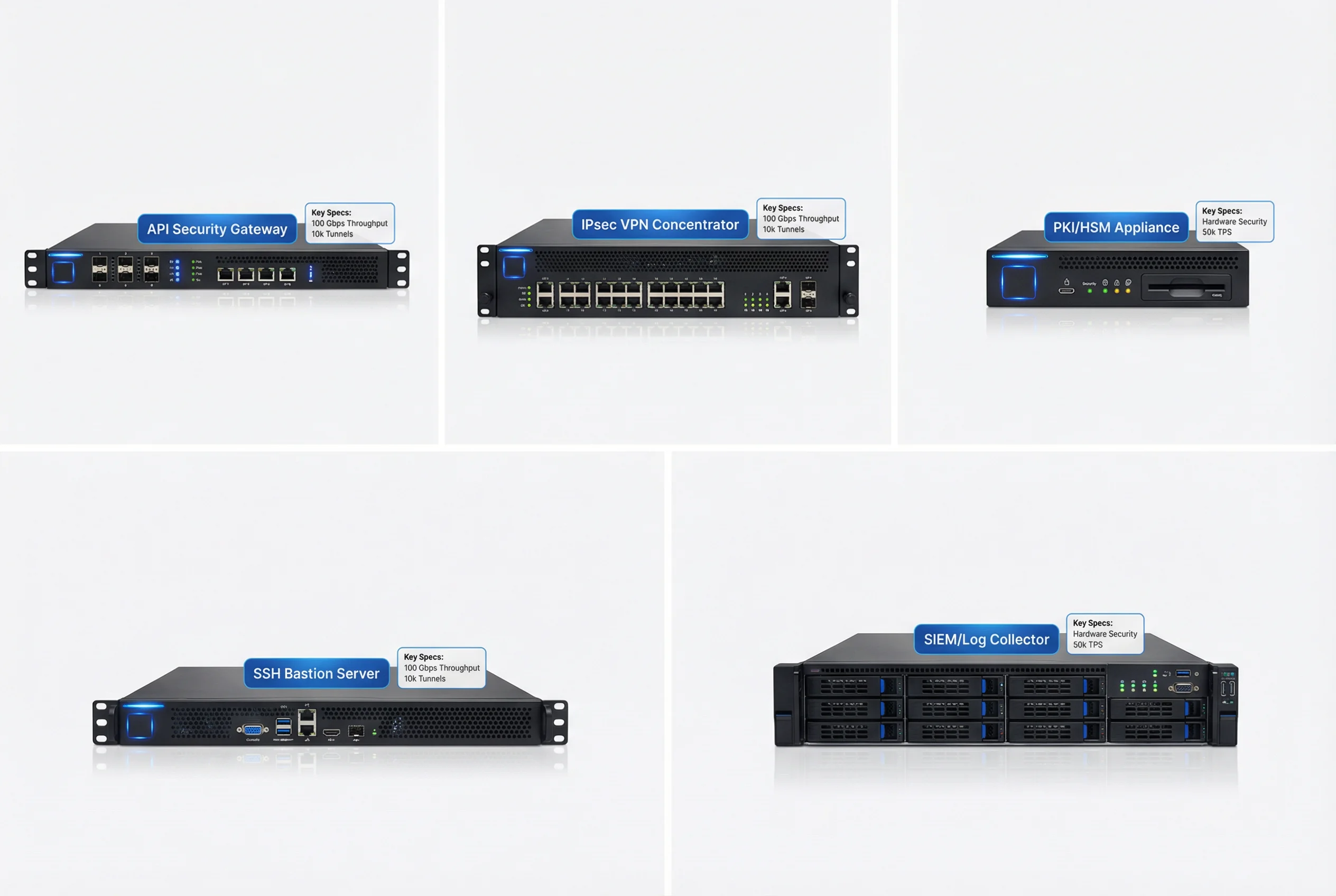
Core Product Feature Table
| Product | Form Factor | Key Interfaces | Max Throughput | HA Support | Certifications | Primary Function |
|---|---|---|---|---|---|---|
| API Security Gateway | 1U Rack | 4x SFP+ 10G (DATA), 2x RJ45 1G (MGMT), 1x Console | 40 Gbps TLS | Active-Active | FIPS 140-2 L2, CC EAL4+ | TLS termination, WAF, OAuth 2.0/JWT enforcement, rate limiting |
| IPsec VPN Concentrator | 2U Rack | 2x WAN (SFP+), 4x LAN (RJ45), 1x OOB MGMT, Dual PSU | 20 Gbps IPsec | Active-Standby | FIPS 140-2 L2, ICSA VPN | IKEv2/IPsec site-to-site, remote access VPN, BGP integration |
| PKI/HSM Appliance | 1U Rack | 2x RJ45 1G (MGMT), Smart card reader, USB, Dual PSU | 50,000 TPS (RSA-2048) | Active-Active cluster | FIPS 140-2 L3, CC EAL4+ | Root/Intermediate CA, key generation, OCSP/CRL, ACME server |
| SSH Bastion Server | 1U Rack | 2x RJ45 1G (MGMT), 1x Console, USB, VGA | 10,000 concurrent sessions | Active-Standby | Common Criteria, SOC 2 Type II | SSH/RDP proxying, MFA enforcement, session recording, PAM integration |
| SIEM/Log Collector | 2U Rack | 4x RJ45 1G (MGMT), 2x SFP+ 10G (Data), 8x HDD bays | 100,000 EPS ingest | Primary + Hot Standby | SOC 2 Type II, ISO 27001 | Log aggregation, correlation rules, alerting, dashboards, 12-month retention |
5.2 Typical Wiring and Interface Logic
Understanding the physical port layout and logical interface assignments is essential for correct installation and troubleshooting. The diagram below shows the front panel of the API Security Gateway and the rear panel of the IPsec VPN Concentrator, along with the logical interface connection diagram that maps physical ports to network zones and protocols. Color coding is consistent with the data center cabling convention: orange for WAN/production, blue for LAN/management, gray for out-of-band management.
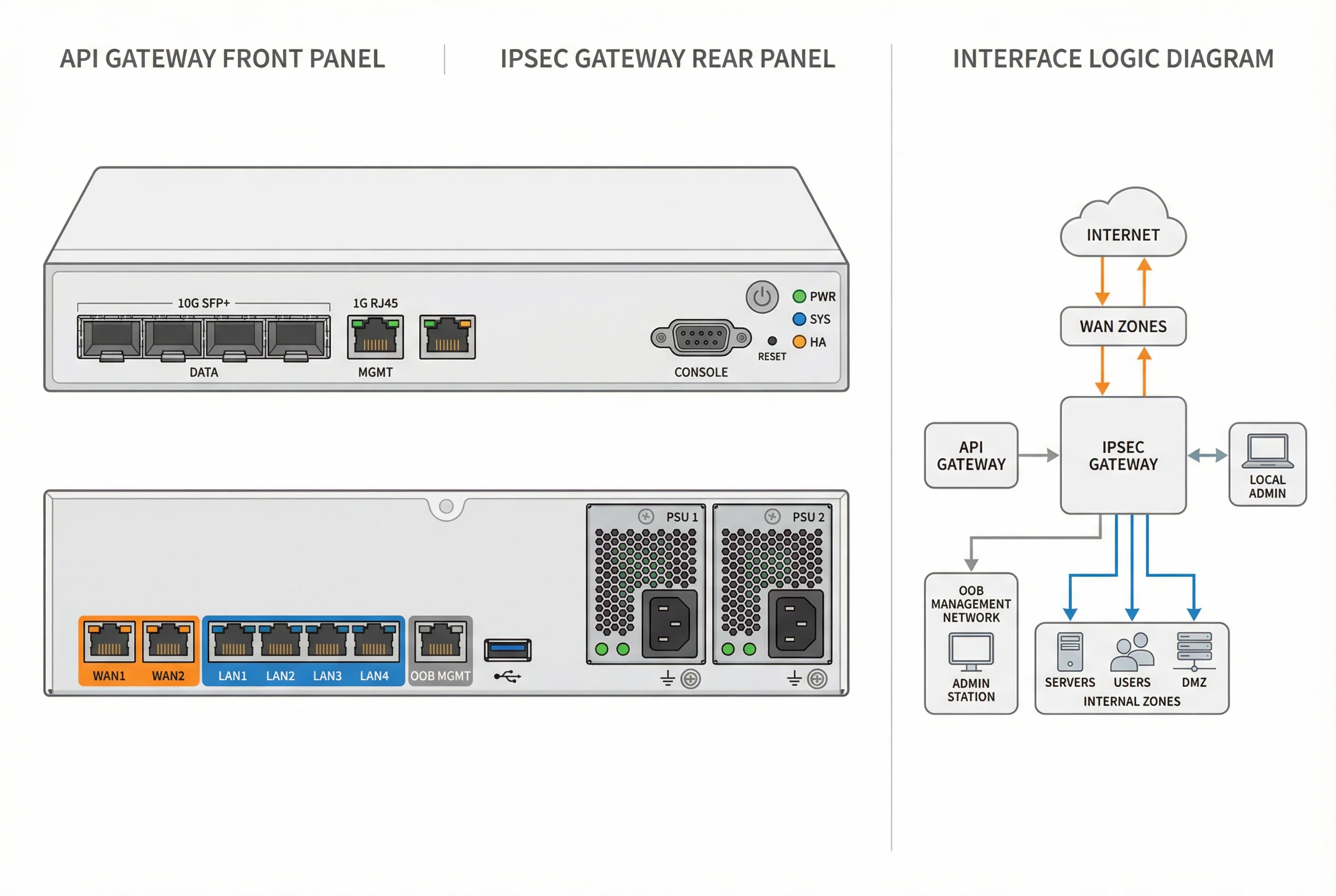
Interface Assignment Reference
| Appliance | Interface Label | Physical Type | Logical Assignment | VLAN | Protocol / Use |
|---|---|---|---|---|---|
| API Gateway | DATA 1–4 (SFP+) | 10G SFP+ | Production traffic (DMZ) | VLAN 10 | TLS 1.3 inbound/outbound |
| API Gateway | MGMT 1–2 (RJ45) | 1G RJ45 | Management network | VLAN 40 | HTTPS management, SNMP, syslog |
| API Gateway | CONSOLE | DB-9 Serial | Local console access | N/A | Serial console (9600 baud) |
| IPsec Gateway | WAN1, WAN2 | 1G RJ45 | Internet-facing WAN | Untagged | IKEv2/IPsec, BGP |
| IPsec Gateway | LAN1–LAN4 | 1G RJ45 | Internal zone connectivity | VLAN 20/30 | Encrypted tunnel endpoints |
| IPsec Gateway | OOB MGMT | 1G RJ45 | Out-of-band management | VLAN 50 | IPMI/iDRAC, SSH management |
| PKI/HSM | MGMT 1–2 | 1G RJ45 | Management network | VLAN 40 | HTTPS (ACME, OCSP, CRL) |
| SSH Bastion | MGMT 1–2 | 1G RJ45 | Admin zone + target servers | VLAN 40/all | SSH-2 proxy, HTTPS admin UI |
| SIEM Server | DATA 1–2 (SFP+) | 10G SFP+ | High-volume log ingest | VLAN 40 | Syslog/TLS, NetFlow, SNMP |
5.3 Product Selection Criteria and Decision Matrix
Selecting the appropriate product tier for each component requires balancing throughput requirements, compliance mandates, budget constraints, and operational complexity. The decision matrix below provides a structured framework for matching organizational requirements to product specifications. Organizations should first determine their peak throughput requirements (with 50% headroom for growth), then identify applicable compliance frameworks, and finally evaluate operational capabilities before finalizing product selection.
| Selection Criterion | Small Enterprise (<500 users) | Medium Enterprise (500–5,000 users) | Large Enterprise (>5,000 users) |
|---|---|---|---|
| API Gateway Throughput | 1–5 Gbps TLS | 10–20 Gbps TLS | 40+ Gbps TLS |
| IPsec Tunnel Count | Up to 100 tunnels | 100–1,000 tunnels | 1,000+ tunnels |
| PKI Certificate Volume | <10,000 certs | 10,000–100,000 certs | 100,000+ certs |
| SIEM EPS (Events/sec) | <5,000 EPS | 5,000–50,000 EPS | 50,000+ EPS |
| HA Requirement | Active-Standby | Active-Active (critical paths) | Full Active-Active + geo-redundancy |
| HSM FIPS Level | FIPS 140-2 L2 | FIPS 140-2 L2/L3 | FIPS 140-2 L3 mandatory |
| Compliance Drivers | ISO 27001, basic | PCI DSS, SOC 2, ISO 27001 | PCI DSS L1, HIPAA, FedRAMP, GDPR |
| Deployment Model | On-premises or cloud-hosted | Hybrid (on-prem + cloud) | Multi-cloud + on-prem |