Support & Integration
7.1 Supporting Infrastructure Overview
The critical data transmission security system does not operate in isolation — it depends on a set of supporting infrastructure components that provide foundational services such as time synchronization, identity resolution, network access control, and vulnerability management. These supporting systems must be deployed and hardened before the core security stack is activated, as failures in supporting infrastructure can cascade into security control failures. For example, an NTP misconfiguration can cause certificate validation failures; an LDAP outage can prevent authentication; a patch management gap can leave known vulnerabilities unaddressed.
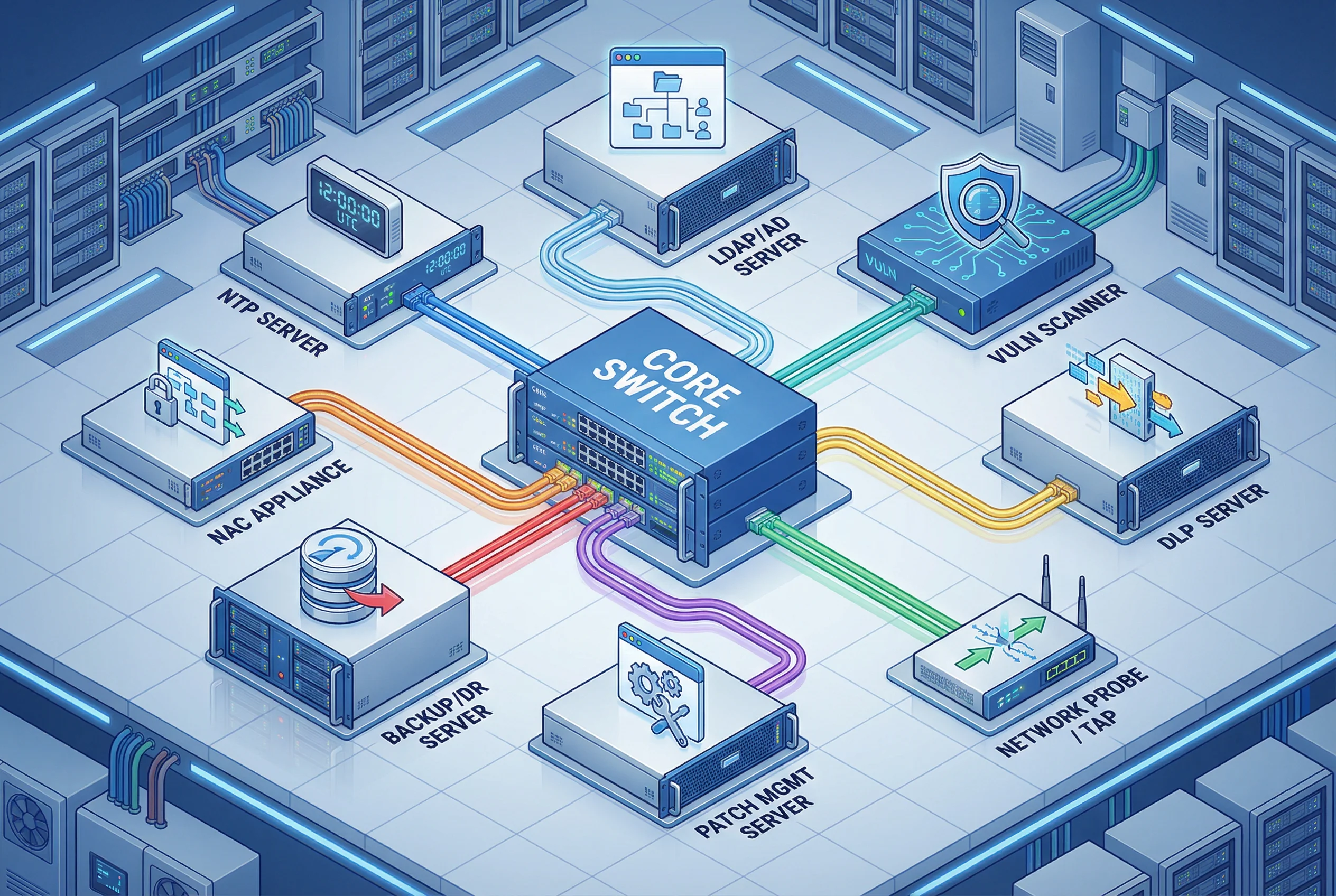
The diagram below shows all supporting systems integrated into a single view, connected to the core network switch. This integrated view helps architects understand the full dependency map and plan maintenance windows that account for inter-system dependencies.
7.2 Supporting System Requirements
Each supporting system has specific deployment, configuration, and integration requirements that must be met for the core security stack to function correctly. The table below provides a consolidated reference for each supporting system, covering its primary function, integration method, minimum configuration requirements, and the core security controls that depend on it.
| Supporting System | Primary Function | Integration Method | Min. Config Requirements | Dependent Controls | HA Requirement |
|---|---|---|---|---|---|
| NTP Server | Accurate time synchronization for all devices | NTP/NTPsec (UDP 123) | Stratum 2 or better; authenticated NTP; max drift ≤ 1 sec | TLS cert validation, log correlation, Kerberos auth | Primary + backup NTP source |
| LDAP/AD Server | User identity, group membership, authentication | LDAPS (TCP 636) or LDAP+STARTTLS | TLS-only LDAP; service account with read-only access; LDAP signing required | SSH bastion MFA, API gateway auth, SIEM user context | Multi-DC AD or LDAP replica |
| Vulnerability Scanner | Identify unpatched vulnerabilities and misconfigurations | Agent-based + credentialed network scan | Weekly authenticated scans; CVSS ≥ 7.0 remediation within 30 days; scan results to SIEM | Patch management prioritization, risk scoring | Single instance (scheduled) |
| NAC Appliance | Enforce device posture before network access | 802.1X (EAP-TLS), RADIUS (UDP 1812/1813) | Certificate-based device auth; posture check (OS patch level, AV status); quarantine VLAN for non-compliant devices | Network segmentation, ZTNA device posture | Active-Standby RADIUS pair |
| DLP Server | Detect and prevent unauthorized data exfiltration | ICAP (TCP 1344) inline with proxy; agent on endpoints | Policy covering PII, PCI data, IP; block + alert on policy violation; logs to SIEM | Partner B2B flows, insider threat detection | Active-Active (inline) |
| Backup/DR Server | Configuration backup and disaster recovery | Encrypted backup over management VLAN | Daily config backup; 30-day retention; encrypted at rest (AES-256); tested restore quarterly | Disaster recovery, configuration audit | Off-site replica required |
| Patch Management Server | Centralized software update deployment | HTTPS agent (TCP 443/8443) | Patch within 30 days (critical: 7 days); test in staging before production; rollback plan required | Vulnerability remediation, compliance | Single instance (scheduled) |
| Network Probe / TAP | Passive traffic capture for forensics and monitoring | Passive TAP or SPAN port; out-of-band to SIEM | Full-duplex TAP on all chokepoints; capture metadata only (no payload for encrypted traffic); 7-day PCAP retention | Incident investigation, NetFlow baseline | Passive (no HA needed) |
7.3 Integration Dependency Map
The integration dependency map defines the order in which supporting systems must be deployed and the dependencies between them. Deploying systems out of order can result in configuration failures or security gaps. The recommended deployment sequence ensures that foundational services (NTP, PKI, LDAP) are available before dependent services (NAC, bastion, SIEM) are configured.
| Deployment Order | System | Prerequisites | Provides To | Integration Test |
|---|---|---|---|---|
| 1 | NTP Server | Network connectivity only | All systems | ntpq -p shows stratum ≤ 2; all devices synchronized within 1 sec |
| 2 | PKI/CA (Core) | NTP synchronized | All TLS/mTLS, LDAPS, RADIUS | Issue test cert; verify chain to root; OCSP responds in < 1 sec |
| 3 | LDAP/AD Server | NTP, PKI (for LDAPS cert) | SSH Bastion, NAC, API Gateway, SIEM | LDAPS bind succeeds; user lookup returns correct groups |
| 4 | NAC Appliance | NTP, PKI, LDAP | Network access enforcement | EAP-TLS auth succeeds; non-compliant device quarantined |
| 5 | SSH Bastion | NTP, PKI, LDAP | Admin access to all servers | SSH session via bastion with MFA; session recorded; log in SIEM |
| 6 | SIEM/Log Collector | NTP, PKI (for syslog TLS) | Centralized visibility for all systems | Logs received from all sources; correlation rule fires on test event |
| 7 | Backup/DR Server | NTP, PKI, SIEM | Configuration resilience | Backup completes; restore test succeeds; backup log in SIEM |
| 8 | Patch Mgmt Server | NTP, LDAP | Software currency for all systems | Agent deployed; patch scan completes; critical patches identified |
| 9 | Vulnerability Scanner | NTP, LDAP, Patch Mgmt | Risk visibility | Credentialed scan completes; results exported to SIEM |
| 10 | Network Probe / TAP | NTP, SIEM | Traffic visibility | TAP captures traffic; NetFlow visible in SIEM; PCAP accessible |
| 11 | DLP Server | NTP, PKI, LDAP, SIEM | Data exfiltration prevention | Test policy violation detected; alert in SIEM; block confirmed |